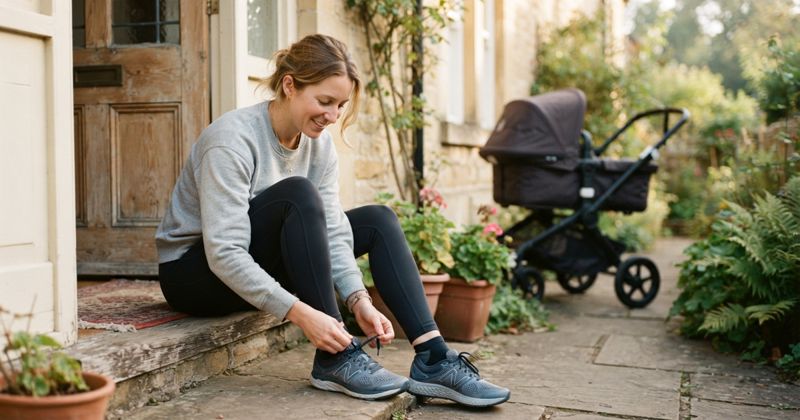
How to buy running shoes when you're a woman
Half a size up, a thumbnail of room at the front, and a healthy scepticism about pronation analysis. What matters when buying running shoes, and what shops get wrong.
Table of contents
There is a lot of noise in running shoe advice and most of it is trying to sell you something. Here is the short version of what actually holds up.
Fit beats everything
The single biggest predictor of whether a shoe works is whether it fits your foot. Not the brand, not the cushioning technology, not the review score.
Go up about half a size from your everyday shoe. Feet swell during a run — by the end of a long one your foot can be noticeably bigger than it was at the start. A shoe that fits perfectly in the shop at 10am is a shoe that will cost you toenails at kilometre eight.
Leave a thumbnail's width in front of your longest toe. Which is not always your big toe.
Shop in the afternoon or after a walk, when your feet are already slightly swollen. Morning fitting gives you a shoe that is half a size too small in practice.
The shoe should be snug at the heel and roomy at the front. Heel slip is a fit problem; a tight forefoot is a size problem. They are not the same and they are not fixed the same way.
The pronation thing
You will probably be offered a treadmill gait analysis and then a "stability" shoe based on how much your ankle rolls inward.
Be politely sceptical. The evidence that matching shoe category to pronation type prevents injury is weak — trials that assigned shoes this way have generally not shown fewer injuries than assigning them at random. Some people genuinely prefer stability shoes because they feel better. That is a fine reason to buy one. "Your arch collapses" is a weaker one than it sounds.
What the analysis is genuinely useful for: spotting a big left–right asymmetry, or something that is obviously painful.
Women's models are not just smaller
Women's-specific lasts are usually narrower at the heel relative to the forefoot, and the cushioning is sometimes tuned for a lighter average body weight. That can be exactly what you want.
It can also mean the shoe you actually need is the men's version in a smaller size — particularly if you have a wide foot. Any decent shop will let you try both. If yours acts like this is a strange request, that tells you something about the shop.
What to ignore
- Colour. Obviously. But brands do still put their best foam in the men's colourway first sometimes, so check the model number, not the picture.
- Carbon plates, if you are starting out. They are built for race-pace efficiency and are unforgiving to run slowly in.
- "Corrective" claims. A shoe does not correct anything. It changes how load is distributed, which is not the same thing.
How many pairs
One is fine to start. Once you are running more than about 30km a week, two pairs you rotate is genuinely useful — the foam decompresses between runs, and slightly different shoes load your legs slightly differently.
Replace them somewhere in the 500–800km range, but let how they feel decide. Midsole foam packs down long before the outsole looks worn, so the tread is a bad indicator. If your legs feel unusually beaten up after ordinary runs, suspect the shoes.
Where this fits
Shoes and a bra that works are the whole equipment list for your first couple of months — see sports bra fitting for the other half. If you are still building up, the eight-week couch to 5K plan is the place to start.